Nancy's Talks
  LLL Canada Health Professional Seminars 2013 
      Regina SK: Sept. 9
      Ottawa, ON: Sept. 11
      Guelph, ON: Sept. 12
      St. John's, NL: Sept. 14 
Tri-County Breastfeeding Connections
Contact: Linda Witmer 330-337-4989
      Boardman, OH
      October 4, 2013
      Chicago, IL
      October 26, 2013
     
Feedback

“Best speaker I’ve heard in a long time. Nancy is expert and wise & has an incredibly broad & deep fund of knowledge.”

“[Nancy] is gifted…great speaking voice and a talent for getting the information across in an understandable way—evidence-based and interesting.”

“Wonderful! Made a difficult topic very simple to understand.”

“An extremely good presentation with excellent research, thought-provoking, up-to-date, practical.”

“Just went to a three-day conference. This two-hour talk was as valuable.”

“Really good use of applied research.”

“Nancy speaks in a manner easy to understand--very down to earth & knowledgeable. Great information.”

“This is the BEST talk I’ve ever heard on the subject—very practical!!”


Friday
May172013

Formula Use & Breastfeeding: The Moral of the Story

Earlier this week a study appeared in Pediatrics that has the media buzzing about whether giving formula in the first few days can actually improve breastfeeding rates. Both Time magazine and the New York Times featured stories on this. Not surprisingly, the media stories (and in my opinion, the researchers themselves) missed the central point.

This study compared breastfeeding outcomes in two groups of mothers whose babies had lost enough weight shortly after birth to be considered at risk. Both groups were given lactation help. In the control group, the mothers were encouraged to exclusively breastfeed. In the intervention group, after each breastfeeding the mothers were instructed to feed their babies by syringe a tiny amount of formula supplement: 10 mL, or about one-third of an ounce. This is about how much colostrum babies consume at each breastfeeding during the first 2 days of life.

The study found that more of the mothers who gave this small amount of formula after feedings breastfed longer and more exclusively than the mothers who didn’t.

Unlike the authors and the media, I don’t interpret these results to mean that early formula can help breastfeeding. In addition to all of the valid points made by other breastfeeding supporters, what was noteworthy to me was that the mothers in the intervention group were taught to supplement their newborns with biologically appropriate feeding volumes consistent with the recommendations of the Academy of Breastfeeding Medicine.

Many parents who supplement—including I’m sure those in this study’s control group—overfeed their babies incredibly, either without realizing it or because they are unwittingly instructed to do so by health professionals. Yesterday I spoke to a mother who was told by a pediatrician to make sure her jaundiced 4-day-old took 2 oz. (60 mL) at every feeding, which is twice the size of a 4-day-old’s stomach. To accomplish this, she was pumping, adding formula to her milk, and force-feeding this massive amount to her newborn.

My take-away message from this study is that any mother who supplements her newborn (whether with expressed milk, donor milk, or formula) should learn the appropriate amount to feed so she can prevent the kind of rampant oversupplementation that undermines breastfeeding and increases later risk of obesity. Babies overfed at this magnitude breastfeed much less often and milk production suffers.

What are the long-term effects of early overfeeding? One study followed to adulthood 653 people who were formula-fed from birth. Amazingly, greater weight gain during the first 8 days of life was associated with increased incidence of overweight 20 to 30 years later.  These researchers concluded that the first 8 days may be a “critical period” during which human physiology is programmed.  This may mean that breastfed babies’ greater weight loss after birth and slower return to birth weight may help promote a healthier metabolic program, which reduces the risk of overweight and obesity during childhood and beyond. At the very least, it most certainly means that parents and health professionals should be extremely wary of overfeeding newborns. To me, that’s the real moral of the story.

References

Academy of Breastfeeding Medicine.  ABM clinical protocol #3: Hospital guidelines for the use of supplementary feedings in the healthy term breastfed neonate. Breastfeed Med 2009; 4(3): 175-82

Bakalar, N. How formula can complement breastfeeding. New York Times, May 13, 2013.

Flaherman, V.J., Aby, J., Burgos, A.E., Lee, K.A., Cabana, M.D., & Newman, T. Effect of early limited formula on duration and exclusivity of breastfeeding in at-risk infants: An RCT. Pediatrics 2013; 131(6):1059-65.

Naveed, M. et al.    An autopsy study of relationship between perinatal stomach capacity and birth weight.  Indian J Gastroentero 1992;11(4):156-58.

Rochman, B. How formula could increase breastfeeding rates. Time, May 13, 2012.

Stettler, N. et al.  Weight gain in the first week of life and overweight in adulthood.  Circulation 2005; 111:1897-1903.

Stuebe, A. Early, limited data for early, limited formula use. Academy of Breastfeeding blog. May 13, 2012


Tuesday
Mar192013

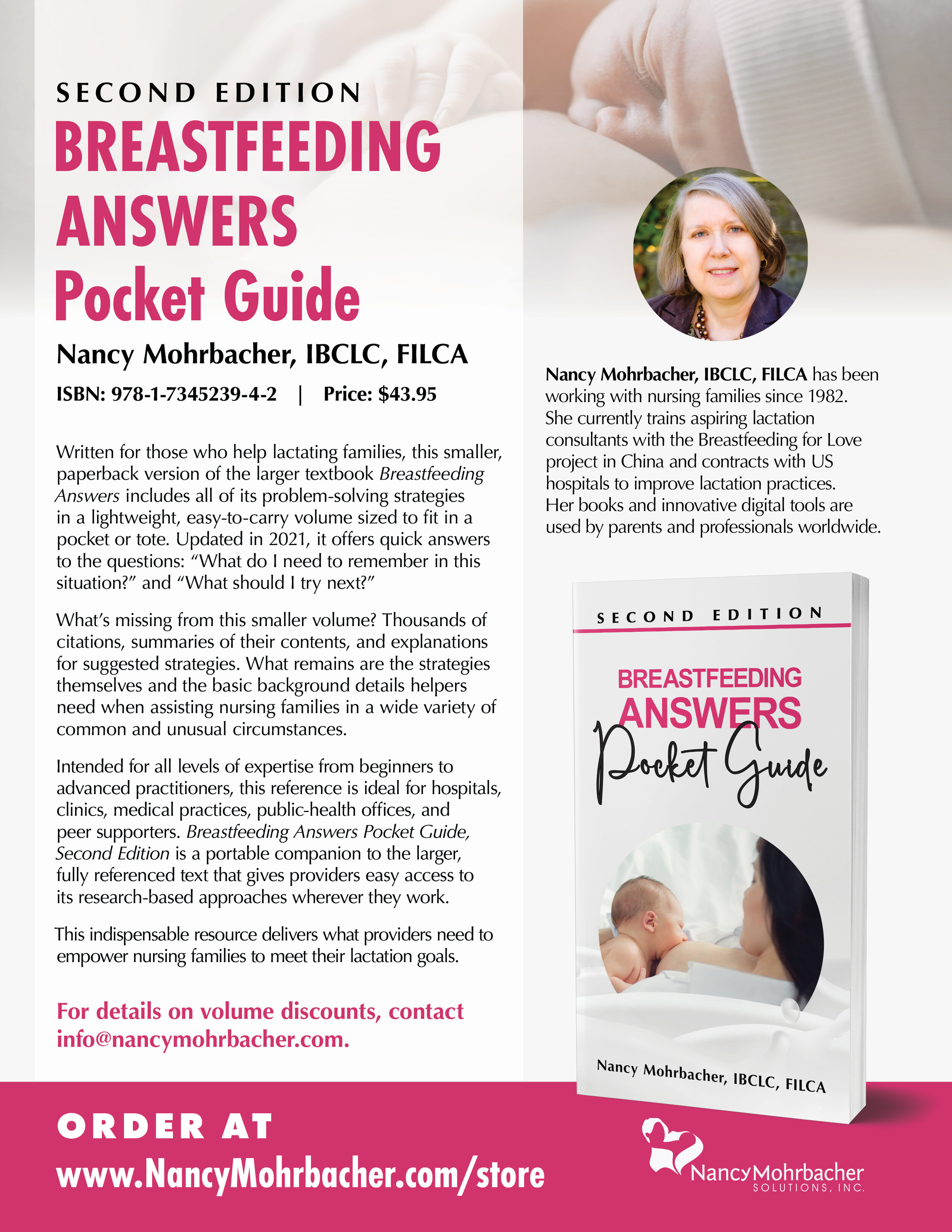
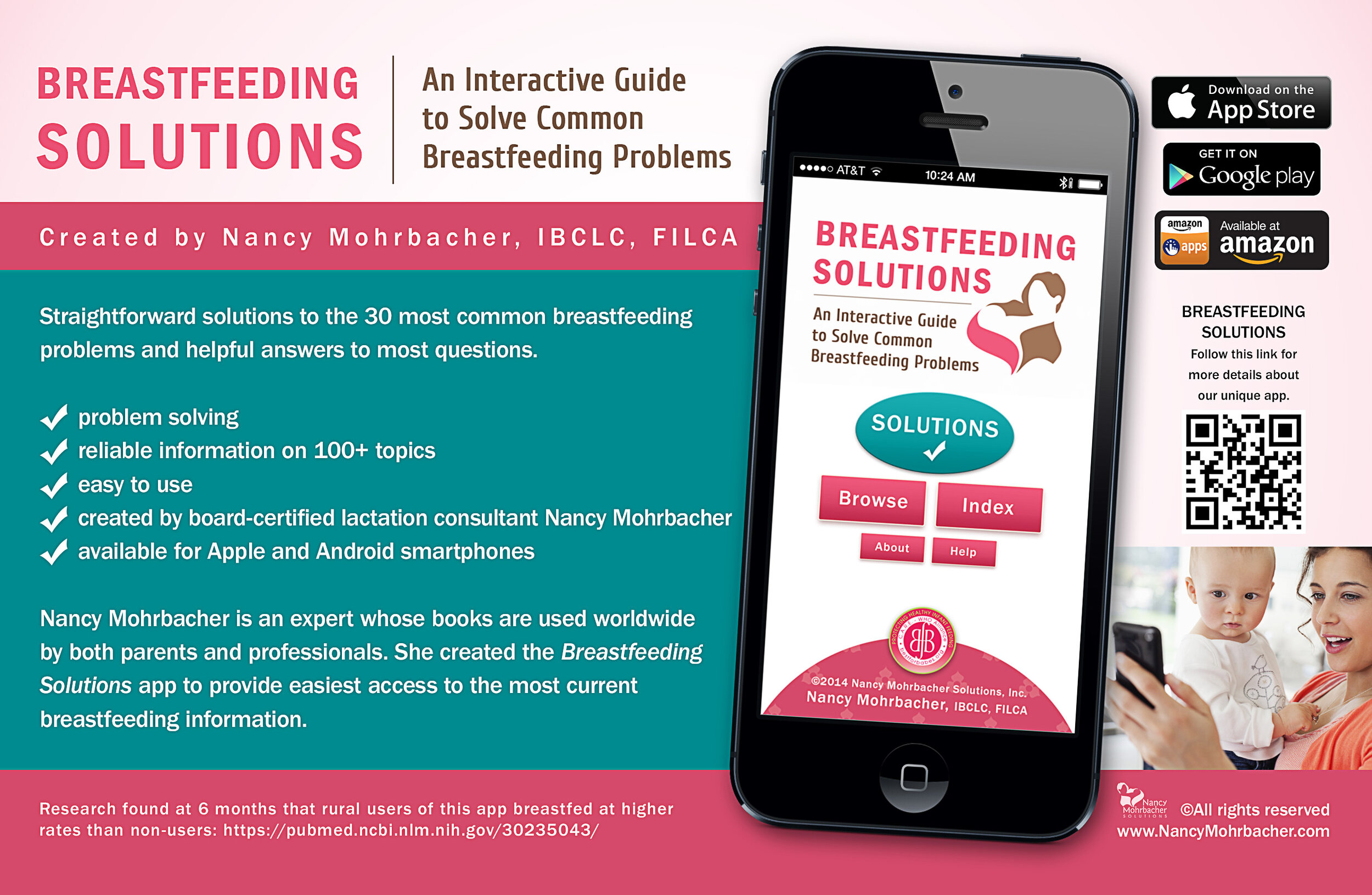
My New Book: Breastfeeding Solutions

Celebrate with me the release of my new book, Breastfeeding Solutions: Quick Tips for the Most Common Nursing Challenges! The book will be in stores and its e-version will be available on Amazon on April 1, but if your order is shipped to a US address, you can receive 30% off the paperback version today at www.newharbinger.com! (If possible, please use a browser other than Internet Explorer, which appears to cause issues with the shopping cart, or through Friday you can place your order by phone between 9 am and 5 pm Pacific time at: 800-748-6273.) For the special code you need in order to receive this 30% discount, go to (and please “Like”) my professional Facebook page at www.Facebook.com/NancyMohrbacherIBCLC. This special US offer, which was originally scheduled to end on Sunday, March 24, has been extended to Wednesday, March 27.

How does Breastfeeding Solutions differ from Breastfeeding Made Simple? Its focus is on problem-solving, and this slim volume was written to simplify mothers’ lives by cutting to the chase. A quick read, it features line drawings, bulleted lists, charts, and other visuals for fast, easy access to the best and most current breastfeeding strategies. It is also organized to make it easy for a mom to skip straight to her burning issue without having to read earlier chapters first.

If you’d like a sneak peek of the book…check out this special excerpt on breastfeeding the teething baby: www.newharbinger.com/teething!

Breastfeeding Solutions will also be available on April 1 through the following distributor:

UK: On June 20, Breastfeeding Solutions will be available in the UK through the distributor Constable & Robinson. For all the info, see this link. It will also be available at www.amazon.co.uk.

Monday
Jan282013

The Mother's Partner and the Breastfeeding Baby

For most couples, the weeks and months after the birth of a baby are some of the most joyful and stressful times of their lives. Along with the miraculous wonder of staring into a newborn’s eyes, comes the fatigue of sleepless nights and the emotional vulnerability of changing roles and shifting relationships.

During this time of transitions, breastfeeding affects family dynamics. Although many couples breastfeed in part for the closeness it brings, they are often unprepared for the intensity of this physical link between mother and baby. Nursing can be more than feeding; for many it is also an act of intimacy. Breastfeeding hormones relax the mother and heighten her sensitivity to her child, evoking an intense desire to respond to his cries. The nursing baby experiences his mother through all five of his senses, finding security and comfort as well as milk at his mother’s breasts.

Since the mother’s partner lacks this intense physical link and natural source of comfort, what does this mean to his or her relationship with the baby? In studies, some fathers of breastfeeding babies report feelings of frustration and inadequacy because they were unable to easily comfort their babies during the mothers’ absence. When they realized their relationship with their baby was different from the mothers’, they reported feeling a sense of loss. Even so, these study fathers continued to support breastfeeding. Those who wanted to be most actively involved with their babies reassured themselves that this difference wouldn’t last forever and found other ways to be involved in their babies’ care. Rather than attempting to duplicate the breastfeeding relationship, they found they could develop their own unique relationship with their children.

For some partners, though, feelings of frustration and inadequacy cause them to back off and become even less involved in their baby’s care, leading to resentment and jealousy at their partners’ absorption with the baby. Some partners perceive the mother-baby bond as a threat.

What should a couple do if the partner begins to develop feelings of resentment or jealousy? In her book, Mothering and Fathering: The Gender Differences in Child Rearing, Tine Thevenin writes:

The adjustment that comes with having a child takes effort and understanding. Instead of allowing misunderstandings about each other’s feelings to create a rift, I would suggest that both partners explore and acknowledge their own–and each other’s–emotional responses, while at the same time adopting an attitude of, ‘How can I be of greatest help in our relationship and our family?’

No matter how the baby is fed, the mother’s partner has an important choice to make. Will he or she feel left out and become a bystander in the baby’s care or take an active role in developing a positive relationship with the baby?

The relationship between the mother’s partner and the child is intimately linked to the emotional health of the whole family. The couple’s relationship will be affected, as well as the mother’s ability to meet her own needs. When a mother has confidence in her partner’s good relationship with their baby, she will feel freer to take the time she needs for herself. And when she sees her baby and her partner happy together, it makes her feel even better about her partner.

WHAT ABOUT BOTTLES?

Although feeding is one way to interact with a baby, many couples have found that giving bottles doesn’t guarantee closeness. Julie Stock, mother of three, discovered this when she walked in on her partner absent-mindedly feeding their firstborn a bottle with his eyes glued to the football game on television. They decided to forgo bottles with their next two children and later she came to the conclusion that during their babyhood “my partner actually felt closer to the two children who didn’t get bottles, because he had to invest more of himself and be more creative during their time together.”

If the partner will be giving bottles, such as when the mother is out for a few hours or when caring for the baby after mother goes back to work, it is best to wait until the baby is about a month old before introducing them. Some babies have difficulty going back to the breast if artificial nipples are introduced early, while they are just learning to breastfeed. Once a baby has been breastfeeding well for three to four weeks, this problem is much less likely to occur.

In the book Becoming a Father pediatrician and father of eight, Dr. William Sears writes:

I discourage supplemental bottles especially during the first month because of the risk of disturbing the breastfeeding harmony that mother and baby are working so hard to establish. Instead I encourage fathers to understand, respect, and support the uniqueness of the breastfeeding relationship….In the meantime, supplemental nourishment from dad should go to the mother.

WHAT PARTNERS CAN DO

There are many other ways a partner can develop a loving relationship with a breastfeeding baby. First, be aware that mixed feelings are normal. And if a baby obviously prefers mother and is unresponsive to the partner at first, it may feel frustrating and discouraging. But even if this happens, it is important to continue to work at the relationship. Some babies take a while to warm up to the partner’s overtures. Sensitivity and patience go a long way toward building closeness.

One way to show sensitivity to a baby is recognize and respond to her cues. Notice what happens when you talk to her. Tiny babies have a short attention span and are easily overstimulated. If she turns away, seems uninterested, pensive, or drowsy, just hold her close or try again later. Eye contact, reaching out, or smiling may mean that she’s ready to interact. Just like adults, each baby is a person with preferences. She may like some ways of touching, holding, and playing and not others. If she likes what you’re doing, keep it up and try it again another time. If she does not respond or seems upset, try something else.

In his book, Becoming a Father, Dr. Sears confesses that he didn’t learn how to be fully involved until his sixth child. His suggestions for partners with babies younger than three months (the age that many find particularly challenging) include a lot of touching and holding, which he feels helps a partner and baby “feel right” together. Some of these early activities include:

  • the “neck nestle,” in which the baby nestles her head against the front of the partner’s neck;
  • the “warm fuzzy,” in which the partner drapes the infant, skin-to-skin over his or her chest with the baby’s ear over the heartbeat
  • various holds that the partner can use to comfort baby
  • bathing together
  • wearing the baby in a carrier or sling
  • infant massage

HOW MOTHER CAN HELP

The mother’s role in encouraging a strong partner-child relationship is one that is very difficult for many new mothers to carry out. During the time when nature programs a mother to protect her baby at all costs, she needs to overcome her natural inclination to hover while the partner cares for the baby. She needs to keep quiet when she feels the urge to comment on or criticize the partner’s efforts. (Does it really matter if at first the baby’s shirt is on backwards and his diaper is a little loose?) She needs to step back and let the partner-child relationship develop without her. The more of a perfectionist the mother is, the more difficult this can be.

Ginny Rossi, a first-time mother, tells how she helped encourage her partner and son to become close:

We started off slow. During the early weeks my partner would sit next to us while we nursed, touching and caressing Marco, and afterwards he would do the burping. Eventually, after burping, Marco began to fall asleep on his dad’s chest and got used to being close to him. After some weeks of this, Marco was more willing to be comforted by his dad.

Now that Marco is eight months old, my partner takes him for a couple of hours every day, and they both look forward to their time together. Not only does it make me happy to see them enjoying each other so much, but this gives me a needed break, which helps me feel better about full-time motherhood. I am convinced that their closeness today stems from their early time together.

In this age of equal partnership between the sexes and in same-sex couples, one of the lessons of pregnancy, childbirth, and breastfeeding is that sharing an equal commitment to parenthood does not mean fulfilling the same roles. Baby stands to benefit most when mother is most fully mother and her partner takes a different role. During a breastfeeding baby’s early weeks and months this may mean that the relationship between mother and baby is more intense. But a newborn needs to develop other relationships, too, and this need grows as he matures. With partner and baby, just as with any relationship, greater investment brings greater rewards.

Saturday
Jan262013

Is Your Formerly Nursing Baby Refusing to Breastfeed?

If your baby is younger than one year, even if she seems to be losing interest in breastfeeding, chances are she is not yet ready to wean. After all, during their first twelve months babies still physically need mother’s milk. If your baby was nursing well and suddenly refuses your breast, this may be what some call a nursing strike. Besides baby’s age, another clue that a nursing strike is not a natural weaning is that baby is unhappy about it. A nursing strike usually lasts two to four days, but it may last as long as ten days. It may take some ingenuity plus the following insights and suggestions to help a striking baby go back to breastfeeding. 

What to Do

When a baby completely refuses the breast, focus first on two things:

1.  Expressing your milk

2.  Feeding the baby

Pump as often as baby was breastfeeding. This avoids uncomfortable breast fullness and helps maintain your milk production. Ideally, if your baby isn’t nursing at all, a double electric breast pump will make this faster and easier and will be more likely to keep up your supply.

Feed your baby your milk. How you feed it depends in part on your baby’s age. A sippy cup is a good choice for a baby at least six to eight months old, as it does not satisfy baby’s sucking urge like a bottle. A younger baby can take your milk by cup, spoon, or even eyedropper.

Most mothers think first of using a bottle, but choosing a feeding method that does not satisfy your baby’s sucking urge may end the strike sooner. When a baby has no other sucking outlets, such as a bottle or pacifier, he will be more motivated to go back to the breast. If your baby has been taking a pacifier regularly, consider giving it a rest until the strike ends and he’s back to breastfeeding.

What Causes a Nursing Strike?

Why do babies who nursed well suddenly refuse the breast or begin to struggle with latching? Before choosing a strategy for overcoming a strike, see if you can determine its cause from the list below.

Physical Causes

  • Ear infection, cold, or other illness
  • Reflux disease, which makes feedings painful
  • Overabundant milk production with a fast, overwhelming flow
  • Allergy or sensitivity to a food or drug mother consumed
  • Pain when held after an injury, medical procedure, or injection
  • Mouth pain from teething, thrush, or a mouth injury
  • Reaction to a product such as deodorant, lotion, or laundry detergent

 Environmental Causes

  • Stress, upset, or overstimulation
  • Breastfeeding on a strict schedule, timed feedings, or regular interruptions
  • Baby left to cry for long periods
  • Major change in routine, like traveling, a household move, or mother returning to work
  • Yelling during breastfeeding
  • A strong negative reaction when baby bites
  • An unusually long separation

 Knowing the cause will make it easier to choose an effective strategy. For example, if an ear infection is the cause, the right medical treatment and time to recover may be the best solution.

Breast refusal is stressful, but it is almost always possible to overcome it and return to breastfeeding. The following basic approaches can reduce your stress and shorten the strike.

Strategies for Overcoming a Strike

Keep time at the breast happy. Avoid turning the breast into a battleground. If your baby fights your attempts to breastfeed, feed another way and spend lots of happy cuddle time at the breast. When your baby is near the breast, talk, laugh, play, and look into his eyes. Make time there emotionally rewarding, and make any feeding time away from the breast emotionally neutral. Hold your sleeping baby against your breast during naptimes to help shorten the strike.

Spend time touching and in skin-to-skin contact. When not feeding, hold baby with his bare torso against your skin, and stay that way as much as possible. This is soothing to both of you, and the hormones released make baby more open to breastfeeding. If needed, throw a blanket over both of you. Take a bath with your baby, and use a sling or baby carrier to keep him close.

Offer the breast while baby is drowsy or in a light sleep. Many babies accept the breast again for the first time while asleep or in a relaxed, sleepy state. Try breastfeeding while baby naps. Use feeding positions baby likes best and experiment. To make the most of your baby’s natural feeding reflexes, start in a semi-reclined position with baby tummy down on your body. Lean back, and allow baby to take naps on your breast.

Trigger immediate milk flow. Pump before offering your breast to give baby milk he doesn’t have to work for. Or first try hand-expressing a little milk onto baby’s lips. If baby goes to the breast but won’t stay there, ask a helper to drip expressed milk on the breast or in the corner of baby’s mouth with a spoon. Swallowing your milk will trigger suckling, which triggers swallowing. If baby comes off the breast, offer more expressed milk and try again.

Try breast shaping and breastfeeding in motion. Shaping the breast so that it’s easier to latch may help baby take the breast deeper and trigger active suckling. Keep in mind that some babies accept the breast only while being walked or rocked, so if baby is not responding to semi-reclined positions, it may be time to get moving.

Try breastfeeding when baby’s not ravenous. To feed well, baby needs to feel calm and relaxed rather than hungry and stressed. If baby’s agitated, calm him first. Some babies will take the breast more easily if they are not very hungry, so try feeding a little milk first, using whatever feeding method is working for you. Start with one-third to one-half of his usual feeding, just to take the edge off his hunger before offering the breast.

Make the most of times that breastfeeding is going well. When baby takes the breast, breastfeed as long as he will suckle. Offer the breast again soon, rather than waiting until he is very hungry.

If your baby takes a bottle but not the breast, try a bait-and-switch. Start by bottle-feeding in a breastfeeding position and, while baby is actively sucking and swallowing, pull out the bottle nipple and insert yours. Some babies will just keep suckling.

Use breastfeeding tools. With the guidance of a lactation professional, the following devices may help you turn the corner.

  • Silicone nipple shield. In some cases, nipple shields can help a baby transition back to the breast, especially if the strike occurred after a period of heavy bottle and pacifier use.
  • At-breast supplementer. These devices provides milk at the breast through a thin tube that attaches to a container. If slow milk flow is an issue, it may help. If not, it may not be a good choice.

If these strategies don’t work, it’s time to get skilled breastfeeding help. Find someone in your area by clicking on this link.  Your technique may need a simple tweak or you may need some breastfeeding tools or help with how to use them.

Breastfeeding is the biological norm, so nearly all breastfeeding struggles have a solution. It’s just a matter of finding it. Even if settled breastfeeding seems impossible now, with time, patience, and skilled help you can make breastfeeding work again.

Monday
Dec172012

The Power of Belief

Currently, two-thirds of US mothers who intend to breastfeed exclusively for at least three months do not reach their goals. Why? The US Surgeon General’s 2011 Call to Action to Support Breastfeeding identified some of the barriers women face:

  • Lack of knowledge
  • Social norms based on bottle-feeding
  • Poor family and social support
  • Embarrassment about breastfeeding in public or social settings
  • Lactation problems
  • Employment and child care
  • Problems related to health-care services

Missing from this list is one personal factor that has been closely linked to breastfeeding duration and exclusivity: “breastfeeding self-efficacy,” or a mother’s belief that she can make breastfeeding work.

Belief Affects Actions

Scientists have found that a mother’s level of breastfeeding self-efficacy is a stronger predictor of whether she meets her goals than whether she gives her baby formula. Some areas that determine a mother’s breastfeeding self-efficacy include whether she knows when baby has finished breastfeeding and if he’s gotten enough milk, if she can help the baby latch well most of the time, if she feels satisfied about how she’s managing breastfeeding, if she breastfeeds comfortably with family members present, her ability to comfort her fussy baby, and whether she continues to breastfeed at every feeding.

Research reveals that a mother’s level of breastfeeding self-efficacy influences her in major ways:

  • whether she decides to breastfeed at all (people avoid tasks they don’t think they can accomplish),
  • the amount of effort she’s willing to devote to it,
  • how she interprets behaviors and events (whether her self-talk encourages or undermines her efforts),
  • her decisions (such as whether or not she gives formula supplements), and
  • how long she continues breastfeeding when faced with difficulties.

Women with low breastfeeding self-efficacy are likely to have little breastfeeding experience and to be more familiar with bottle-feeding. During pregnancy, they may say they will “try” breastfeeding but doubt that it will work. They may spend little or no time learning about it and feel greater stress when baby is at breast. They may worry that frequent breastfeeding—which is normal—is a sign they don’t have enough milk. They may give up quickly rather than trying to learn more or find a solution to a problem. Many begin supplementing with formula early “just in case.”

Pathways to Confidence

Breastfeeding self-efficacy is not a constant. It is a variable that can go higher or lower, depending on a mother’s experiences and actions. Research has identified four pathways to greater breastfeeding self-confidence. Using these four pathways can help mothers find the inner resources they need to reach their breastfeeding goals.

Mastering breastfeeding. The first pathway is positive personal experiences. Experienced breastfeeding mothers believe they can make breastfeeding work because they have already mastered it. Success reinforces success, which can start with small victories as they learn.  This is also referred to as “task mastery.”  

Watching other mothers breastfeed. This pathway, also known as “modeling,” can be used before a mother has much personal experience. This explains why mother-to-mother breastfeeding support increases breastfeeding duration. Time with other mothers and their thriving breastfed babies relieves doubts and proves that breastfeeding can work. New mothers may feel as though “if they can do it, so can I.” New York lactation consultant Diane Wiessinger describes how this transformation occurs:

“I remember a well-educated client, a speech pathologist with a specialty in geriatric problems. No amount of reassurance on my part gave her confidence that her baby’s squeaks and gurgles were normal. They were, after all, the very sounds about which she warned her nursing-home students. I invited her to a breastfeeding support group. The dozen or so mothers all nodded calmly when she described the sounds: “Yes, our babies do that too. Maybe it’s because they can’t clear their throats.” They showed the same calm unanimity over several other anxious questions she asked: “Yes, our babies spit up sometimes. It looks like a lot, doesn’t it? Especially on a mother-in-law!” “Yes, our babies often want to nurse within minutes of seeming full. We don’t know why. More nursing seems to work.” Afterwards, my client told me, “You know, I was going from here straight to the doctor’s. Now I think I’ll just go home and enjoy my baby.”

Encouragement and support from others.  Mothers can also find this at mother-support gatherings and through phone and online contact with supportive women. On the flip side, criticism is more effective at decreasing self-efficacy than encouragement is at boosting it. In other words, the more time mothers spend with those who discourage their efforts, the lower their confidence in breastfeeding is likely to be.

Physical comfort and positive emotions. A mother’s physical and emotional states have a major effect on her level of self-efficacy. If she is tired, in pain, stressed, or anxious, this decreases her confidence that she can meet her goals. If she feels rested, calm, happy, and comfortable, this boosts her confidence.

How can breastfeeding supporters use this information to boost breastfeeding self-efficacy in the mothers they help?

  • Before and after birth, share the knowledge and skills that make breastfeeding work
  • Help mothers reduce pain or fatigue by offering effective strategies to overcome problems
  • Encourage women to spend time with breastfeeding mothers
  • Provide support and encouragement

Avoid using fear to motivate mothers, which may decrease breastfeeding self-efficacy. Instead provide positive reinforcement, reframe self-defeating thoughts, and create opportunities to practice key skills.

Mothers with high breastfeeding self-efficacy are more likely to seek help when needed and to access available resources. They are more likely to devote time and effort to overcoming breastfeeding problems. They are also more likely to persist until they reach their goals. Widespread efforts to help more mothers achieve greater breastfeeding self-efficacy could help many more reach their breastfeeding goals.

References

Bandura, A. 1997. Self-efficacy: The Exercise of Control. New York: W. H.  Freeman and Company.

Bolton, T. et. al. 2009. Characteristics associated with longer breastfeeding duration: An analysis of a peer counseling support program. J Hum Lact, 25(1):18-27.

Bowles, B.C. 2011. Promoting breastfeeding self-efficacy: Fear appeals in breastfeeding management. Clin Lact 2 (1): 11-14.

Dennis, C-L. 2003. The Breastfeeding Self-Efficacy Scale: Psychometric assessment of the short form. JOGGN 32(6):734-744.

Dennis, C-L. 1999. Theoretical underpinnings of breastfeeding confidence: A self-efficacy framework. J Hum Lact 15(3): 195-201.

Dunn, S., Davies, B., McClearly, L., Edwards, N., & Gaboury, I. 2006. The relationship between vulnerability factors and breastfeeding outcomes. JOGNN, 35(1), 87-96.

Perrine, C.G., Scanlon, K.S., Li, R., Odom E., & Grummer-Strawn, L.  2012. Baby-friendly hospital practices and meeting exclusive breastfeeding intention. Pediatrics 130(1): 54-60.

U.S. Department of Health and Human Services. 2011. The Surgeon General’s Call to Action to Support Breastfeeding. Washington, DC: U.S. Department of Health and Human Services, Office of the Surgeon General.

Wiessinger, D. 2002. “Last step first.” In Current Issues in Clinical Education, edited by K. Auerbach, 69-73. Sudbury: Jones and Bartlett.